
Not All Golf Credentials Are Created Equal: The PGTAA Difference
- Details
- Category: Inside Golf
- Published: 2026-10-06
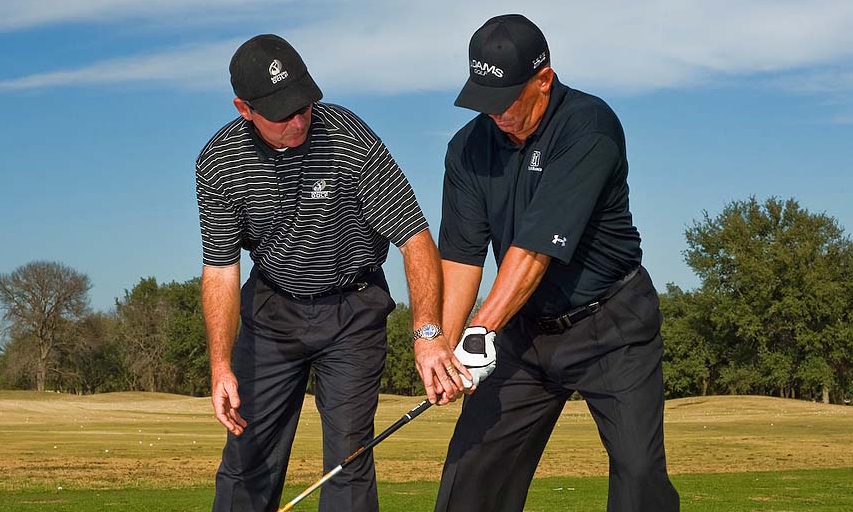
Dr. Barry Lotz, J.D., Ph.D., PGTAA
Why the Letters After Someone’s Name Don’t Necessarily Tell You Who Can Teach Golf
There is a fundamental distinction in the golf industry that too many aspiring instructors — and, frankly, too many golfers — fail to recognize: Being a golf professional and being a professional golf teacher are not necessarily the same thing.
For 29 years, the Professional Golf Teachers Association of America (PGTAA) has built its reputation around that distinction. I founded the PGTAA in 1997 with one overriding purpose: to train and certify people to teach golf.
Not to manage a golf shop. Not to oversee food and beverage operations. Not to maintain a golf facility. Not to organize tournaments. Not to become a generalist in golf-club operations.
To teach golf.
That distinction is just as important today as it was when the PGTAA began.
What Does “PGA Professional” Actually Mean?
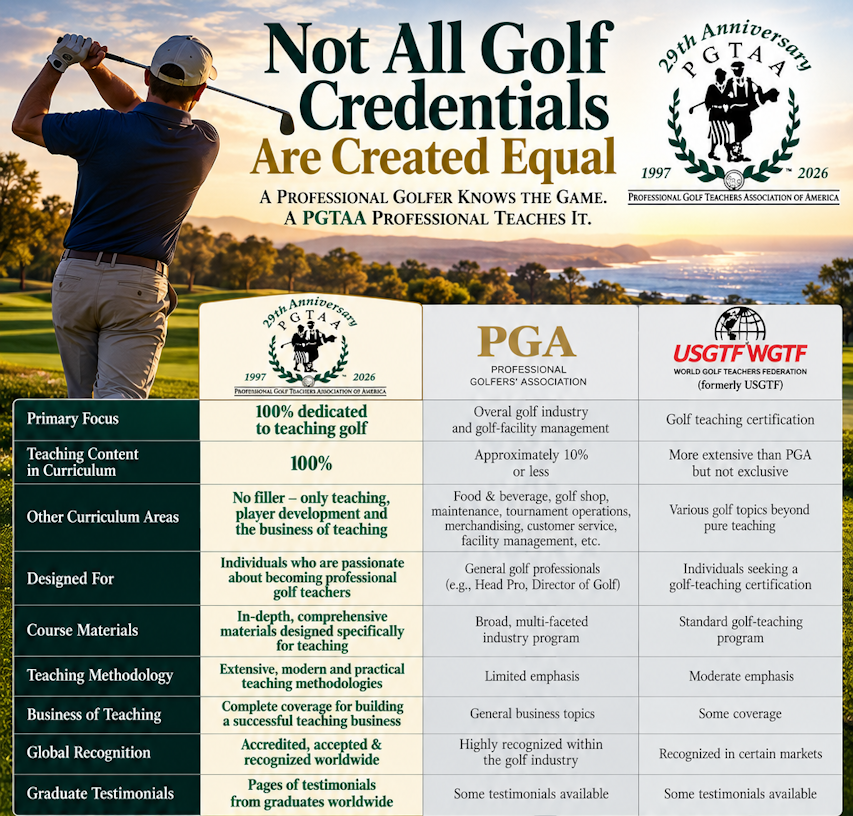
The words “PGA Professional” carry considerable prestige within the golf industry, and deservedly so. PGA Professionals can be extremely knowledgeable individuals performing important roles throughout the golf business. But the designation should not automatically be interpreted to mean a specialist golf teacher.
The PGA professional-development pathway is intentionally broad because PGA Professionals may be required to understand virtually every aspect of the golf industry. Their education can encompass golf operations, tournament administration, merchandising, golf-shop management, customer service, facility management, food and beverage operations, agronomy, player development, and numerous other responsibilities associated with operating a successful golf facility.
Teaching is certainly part of that education, but it is only one part. Depending upon the particular program and pathway, teaching represents approximately 10% or less of the broader curriculum. That makes perfect sense for someone preparing to become a Head Professional, Director of Golf, golf-facility manager, or another type of golf-industry professional. But it raises an obvious question: If your objective is specifically to become an exceptional golf teacher, why would you choose an educational program in which teaching constitutes only a fraction of what you study?
A PGA designation tells me that someone has received education in the golf industry. It does not, standing alone, tell me whether that individual can diagnose a student’s ball flight, recognize the root cause of a swing problem, communicate a correction effectively, understand different learning styles, teach a beginner, develop a student’s short game, or improve a golfer’s putting and mental performance. Those are different skills.
There are unquestionably outstanding PGA teaching professionals. Some of the finest golf instructors in the world hold PGA credentials. But they became outstanding teachers because they developed expertise in teaching, not simply because the letters PGA appeared after their names. A credential may identify a golf professional. Results identify a golf teacher.
Knowing Golf Is Not The Same As Teaching Golf
This is a distinction I have emphasized throughout the PGTAA’s history: Knowing how to play golf does not mean you know how to teach golf. Likewise, understanding the golf business does not automatically make someone an accomplished golf instructor.
Being able to identify a swing fault is one skill. Understanding why it is happening is another. Knowing how to correct it is another. And being able to communicate that correction to a 65-year-old beginner, a talented junior, a scratch golfer, and a frustrated 20-handicapper may require four completely different approaches. That is teaching.
Teaching requires technical knowledge, observation, communication, psychology, patience, adaptability, and the ability to translate complex information into something the individual student can understand and execute. A great teacher does not merely tell a student what is wrong. A teacher determines why it is wrong and then finds the most effective way to communicate and correct it. Those are precisely the capabilities around which the PGTAA curriculum has been developed.
What About The USGTF/WGTF?
The same principle applies when comparing the PGTAA with organizations such as the United States Golf Teachers Federation (USGTF) and World Golf Teachers Federation (WGTF). An organization’s name does not determine the quality of its educational program. A certificate does not determine it. An acronym certainly does not determine it. The course materials do. That is where prospective golf teachers should focus their attention.
Ask: What am I actually going to learn? How comprehensive are the course materials? How deeply does the curriculum address the actual art and science of teaching golf? Will I learn how to diagnose rather than merely observe? Will I learn how to communicate with different types of students? Will I understand not merely what is wrong with a golf swing, but why it is happening and how to teach the correction? Will I learn swing mechanics, ball-flight diagnosis, short game, putting, the mental game, equipment, student evaluation, lesson structure, and the business of developing a successful teaching practice?
These are the questions that matter. And this is where I believe the PGTAA separates itself.
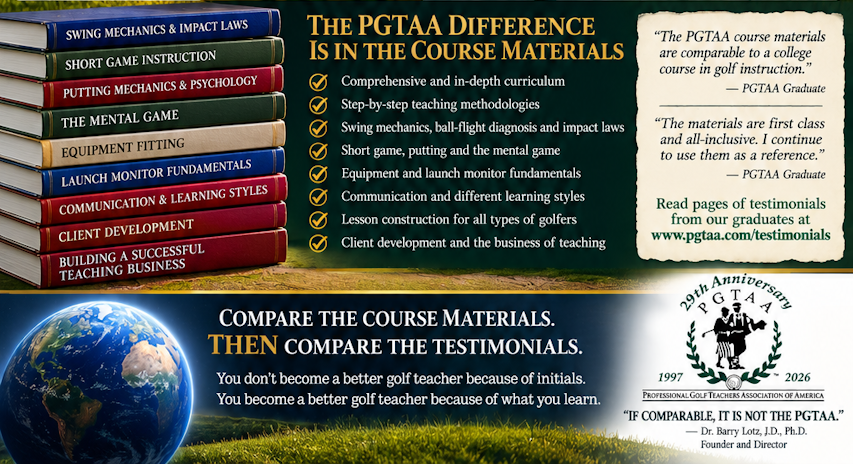
The PGTAA Difference Is In The Course Materials
The PGTAA does not need to become the PGA. It does not need to become the USGTF or WGTF. And it has no interest in being comparable to either. The PGTAA’s advantage is its specialization, the depth of its course materials, and its singular concentration on developing better golf teachers.
Our curriculum is built around teaching.
It includes:
Swing mechanics and impact laws
Ball-flight diagnosis
Student evaluation
Short-game instruction
Putting mechanics and psychology
The mental game
Equipment fitting
Launch-monitor fundamentals
Communication and different learning styles
Lesson construction
Teaching beginners through accomplished players
Client development
Building and operating a successful golf-teaching business
There is no need to fill a teaching curriculum with subjects primarily designed for somebody who wants to manage a golf facility. Our objective is different.
We want the PGTAA graduate to understand how to teach another human being to play better golf. And perhaps one of the most important elements of our educational philosophy is something remarkably simple: Can you explain it to a beginner?
Knowing something and being able to teach it are entirely different abilities. A person can understand every technical component of a golf swing and still be incapable of communicating that knowledge effectively to the student standing in front of them.
Great teachers don’t merely dispense information. They observe, diagnose, listen, communicate, adapt, demonstrate when appropriate, and then they verify that the student actually understands what has been taught. That philosophy runs throughout the PGTAA program.
Don’t Take Our Word For It; Read What Our Graduates Say
Naturally, every certification organization is going to tell prospective students that its program is excellent. So don’t simply take our word for it. Go to the PGTAA website and read the pages of testimonials from our graduates. These are not theories about what the PGTAA might accomplish. They are the experiences of men and women who have actually enrolled in the program, studied the materials, completed the certification process, and taken their PGTAA education into the real world.
Again and again, our graduates discuss the quality, comprehensiveness, and practical value of the PGTAA course materials. One graduate compared the materials to “a college course in golf instruction.” Another described them as “first class and all-inclusive.” Others have explained how they continue using the materials as a teaching reference long after completing their certification.
That is important.
The PGTAA website contains pages of testimonials accumulated over many years from graduates around the world. They include individuals who have gone on to teach professionally, develop golf academies, coach teams, work at golf facilities, and build successful independent teaching businesses. Some describe obtaining new teaching positions. Others report growing their lesson clientele and income. Others speak about the confidence and professional credibility the program gave them to transform a passion for golf into a teaching career.
Those testimonials provide powerful validation of the PGTAA curriculum. Any organization can produce a certificate, create an impressive website, and place initials after someone’s name. But when graduate after graduate, over many years, independently describes the quality of the education, the comprehensiveness of the materials, and the impact the program has had upon his or her teaching career, prospective students should pay attention.
Compare The Course Materials, Then Compare The Testimonials
This is the challenge I would give anyone considering professional golf-teacher certification: Put the programs side by side. Don’t compare acronyms. Don’t compare titles. Don’t assume that “PGA Professional” automatically means “expert golf teacher.” And don’t assume that two golf-teacher certifications provide equivalent education simply because their organizations award similar-sounding credentials.
Compare what they actually teach. Ask to see the curriculum. Examine the course materials. Compare their depth, their teaching methodologies, the emphasis placed upon student evaluation, their treatment of the mental game, their practical teaching tools, and how they prepare graduates to build a teaching business. And then compare the testimonials.
Ask what graduates say after they have completed the program. That is where the real story is found.
Generalist Vs. Specialist
I believe the distinction can ultimately be summarized very simply: The PGA Professional is educated as a golf-industry generalist. The PGTAA Master Teaching Professional is educated as a teaching specialist. That distinction does not have to diminish either profession. They serve different purposes.
If you want a career involving golf operations, merchandising, tournaments, food and beverage, facility management, and the broader golf business, the PGA pathway can make considerable sense. But if your overriding objective is to teach golf, shouldn’t your education overwhelmingly be about teaching golf?
That was the philosophy behind the PGTAA when I founded it in 1997. Twenty-nine years later, it remains our philosophy.
A Credential Must Mean Something
The golf industry has no shortage of certifications, titles, acronyms, and impressive-looking diplomas. But certification should represent considerably more than completing a course and receiving another set of initials after your name. It should represent competence.
When someone identifies themselves as a Class “A” PGTAA Master Teaching Professional, I want golfers to understand what those words are intended to represent: A person educated specifically in the craft of teaching golf.
That is also why the PGTAA curriculum continues to evolve. Golf technology changes. Equipment changes. Teaching methodology changes. Our understanding of learning and performance changes. Launch monitors, video analysis, and modern diagnostic technologies have changed the way instructors evaluate golfers.
But one thing should never change. The fundamental responsibility of a golf teacher remains: Understand the student, diagnose the problem, communicate the solution, verify understanding, and produce improvement.
Twenty-Nine Years; One Mission
Since 1997, the Professional Golf Teachers Association of America has remained committed to one principal mission: Creating better golf teachers.
We have never attempted to become everything to everybody in golf. We don’t need to. Our strength comes from knowing precisely who we are and what we do.
For anyone considering professional golf-teacher certification, therefore, my advice is straightforward: Don’t be overly impressed by initials. Don’t assume a golf-industry credential automatically establishes teaching expertise. Don’t assume that different golf-teacher certifications are equivalent.
Instead, ask one question: Which program is going to make me the better golf teacher?
Then compare the course materials. Compare the curriculum. Compare the teaching emphasis. And read the pages of testimonials from the people who have already completed the journey.
Because, ultimately, the quality of a certification is not determined by the size of the organization issuing it, the number of letters in its acronym, or how effectively it markets itself. It is determined by the quality of the education behind the credential and the ability of its graduates to teach.
That is the standard against which the PGTAA has chosen to be judged. After 29 years, I am entirely comfortable with that comparison.